Once in a while it is good to learn the roots of our professions,
future professions, and hobbies. According to the Computer Sciences Accreditation Board there are four major areas of computer science: computation, algorithms
and data structures, programming methodology, and computer architecture. Now
each area is important in its own way, but this post is about algorithms. Now
an algorithm is defined as “an effective method expressed as a finite list,” in
other words an algorithm has to have an end. Mathematical algorithms are used
to teach programming, such as the Fibonacci sequence.
In 1842, a mathematician and writer named Ada Lovelace
created what is believed to be the first computer program and is well known to
be the first computer programmer ever. Lovelace wrote many notes and algorithms
to be computed on the “Analytical Machine” created by Charles Babbage. Her
algorithms were the first algorithms intended to be used on the "Analytical
Machine" and because of that, her notes are considered the first algorithm
intended to be used on a computer making her the first computer programmer.
Unfortunately the "Analytical Machine" was never fully completed so Lovelace
never had her algorithms tested.
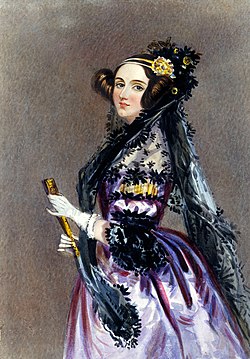 |
| Augusta Ada Byron a.k.a. Ada Lovelace |
Ada Lovelace’s legacy has been imprinted in modern times.
The U.S. Department of Defense created a programming language named after
Lovelace and Google Doodle was dedicated in her honor. It is always nice to
remember that programming is not as recent as we think it is and it older than
one hundred years.

No comments:
Post a Comment